
Humanities & Social Sciences
India and imperial vulnerability
Knowledge, aesthetics and subjects in British discourses of disaster, 1763-1939
by Pramod K Nayar
Description
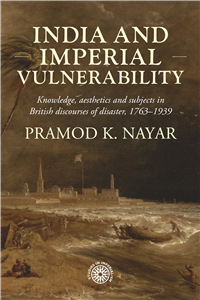
This study of famines, earthquakes and cyclones in British India, 1770-1934, moves from the aesthetics of representation through the knowledge cultures that sprang up around the disasters and finally the construction of the helpless native and the labouring Englishman. It studies the creation of imperial networks of knowledge acquisition, codification and training, as well as the employment of certain aesthetic modes when speaking of the land's disasters. It pays attention to the categorization of the disaster victims and the work of the Englishman in understanding and helping the native. The study shows how the disasters were shaped and were shaped by imperial discourses of knowledge and learning, aesthetics of fright and horror and the labouring English.
More Information
Rights Information
Albania, Algeria, Angola, Argentina, Armenia, Australia, Austria, Bahrain, Belgium, Belize, Benin, Bolivia, Bosnia and Herzegovina, Botswana, Brazil, Bulgaria, Burkina Faso, Burundi, Cameroon, Canada, Cape Verde, Central African Republic, Chad, Chile, China, Colombia, Comoros, Congo [DRC], Congo, Republic of the, Costa Rica, Ivory Coast, Croatia, Czech Republic, Denmark, Djibouti, Ecuador, Egypt, El Salvador, Equatorial Guinea, Eritrea, Estonia, Ethiopia, Faroe Islands, Finland, France, French Guiana, Gabon, Gambia, Georgia, Germany, Ghana, Greece, Guatemala, Guinea, Guinea-Bissau, Guyana, Honduras, Hongkong, Hungary, Iceland, India, Indonesia, Iran, Iraq, Ireland, Israel, Italy, Japan, Jordan, Kazakhstan, Kenya, Kuwait, Latvia, Lebanon, Lesotho, Liberia, Libya, Lithuania, Luxembourg, Macau, China, Macedonia [FYROM], Madagascar, Malawi, Malaysia, Mali, Malta, Mauritania, Mauritius, Mayotte, Mexico, Mongolia, Montenegro, Morocco, Mozambique, Namibia, Netherlands, New Zealand, Nicaragua, Niger, Nigeria, Norway, Oman, Pakistan, Panama, Paraguay, Peru, Philippines, Poland, Portugal, Puerto Rico, Qatar, Reunion, Romania, Russia, Rwanda, Saint Helena, Sao Tome and Principe, Saudi Arabia, Senegal, Serbia, Seychelles, Sierra Leone, Singapore, Slovakia, Slovenia, Somalia, South Africa, South Korea, Spain, Sri Lanka, Sudan, Suriname, Swaziland, Sweden, Switzerland, Syria, Taiwan, Tanzania, Thailand, Timor-Leste, Togo, Tokelau, Tunisia, Turkey, Uganda, Ukraine, United Arab Emirates, United Kingdom, United States, Uruguay, Venezuela, Vietnam, Western Sahara, Yemen, Zambia, Zimbabwe, South Sudan, Cyprus, Palestine, Bangladesh, Cambodia, Liechtenstein, Azerbaijan, Jamaica, Kyrgyzstan, Dominican Republic, Myanmar, Monaco
Endorsements
[Final] India and imperial vulnerability explores how British writings on floods, cyclones, earthquakes and famines - spanning the seventeenth to early twentieth centuries - cast India as a natural laboratory for the study of these phenomena. In these accounts, the subcontinent emerged as a space of endemic disaster, enabling the production of imperial knowledge and and as the site of humanitarian labour by the English. Drawing on a wide range of primary sources - from eyewitness testimonies, official reports, memoirs and scientific treatises - the book investigates the writing of disaster, knowledge-practices and relief. It examines the rhetorical and epistemic frameworks through which both environmental and human suffering were rendered legible: from methods of data collection and narrative organization to the aesthetic portrayal of devastated landscapes and broken bodies. Colonial disaster writing not only reiterated familiar stereotypes, such as the irrational or superstitious native, but also generated new figures: the dignified yet deserving famine victim, and the stoic Englishman, committed to the labour of imperial humanitarianism. Disaster writing and its rhetorical modes constructed various categories of victim-subjects deserving or not of humanitarian aid. It also concomitantly constructed the figure of imperial authority, the humanitarian and the scientifically minded observer, where the Englishman was the ameliorative force in a land the writings defined as disaster-prone. 'Imperial vulnerability', this book argues, was central to the imagining and representation of the multiple roles of the Englishman, from observer to relief-provider.
Reviews
[Final] India and imperial vulnerability explores how British writings on floods, cyclones, earthquakes and famines - spanning the seventeenth to early twentieth centuries - cast India as a natural laboratory for the study of these phenomena. In these accounts, the subcontinent emerged as a space of endemic disaster, enabling the production of imperial knowledge and and as the site of humanitarian labour by the English. Drawing on a wide range of primary sources - from eyewitness testimonies, official reports, memoirs and scientific treatises - the book investigates the writing of disaster, knowledge-practices and relief. It examines the rhetorical and epistemic frameworks through which both environmental and human suffering were rendered legible: from methods of data collection and narrative organization to the aesthetic portrayal of devastated landscapes and broken bodies. Colonial disaster writing not only reiterated familiar stereotypes, such as the irrational or superstitious native, but also generated new figures: the dignified yet deserving famine victim, and the stoic Englishman, committed to the labour of imperial humanitarianism. Disaster writing and its rhetorical modes constructed various categories of victim-subjects deserving or not of humanitarian aid. It also concomitantly constructed the figure of imperial authority, the humanitarian and the scientifically minded observer, where the Englishman was the ameliorative force in a land the writings defined as disaster-prone. 'Imperial vulnerability', this book argues, was central to the imagining and representation of the multiple roles of the Englishman, from observer to relief-provider.
Author Biography
Pramod K Nayar is Senior Professor of English and holder of the UNESCO Chair in Vulnerability Studies at the University of Hyderabad, India.
 Trusted Partner

Manchester University Press
Manchester University Press is a leading UK publisher known for excellent research in the humanities and social sciences.
View all titlesBibliographic Information
- Publisher Manchester University Press
- Publication Date May 2026
- Orginal LanguageEnglish
- ISBN/Identifier 9781526178114 / 1526178117
- Publication Country or regionUnited Kingdom
- FormatPrint PDF
- Pages240
- ReadershipGeneral/trade; College/higher education; Professional and scholarly
- Publish StatusPublished
- Dimensions234 X 156 mm
- Biblio NotesDerived from Proprietary 5940
- SeriesStudies in Imperialism
- Reference Code16465
Thank you for proceeding with this offer.
Manchester University Press has chosen to review this offer before it proceeds.
You will receive an email update that will bring you back to complete the process.
You can also check the status in the My Offers area
Manchester University Press has chosen to review this offer before it proceeds.
You will receive an email update that will bring you back to complete the process.
You can also check the status in the My Offers area

Please wait while the payment is being prepared.
Do not close this window.

(c) Copyright 2026 - Frankfurter Buchmesse GmbH. All Right Reserved