Your Search Results

      • Ediciones Culturales Internacionales, S.A.

        Ediciones Culturales Internacionales is a Spanish publishing house founded in 1983. Is currently one of the most experienced companies in the publishing field. Specialized in the production and publishing of books, it is distributed in various Latin American countries. Ediciones Culturales Internacionales has projected itself as a leading publishing company in its field, being a participant in the cultural and intellectual life of our country. Our Mission: Edit books with the highest quality in terms of materials and content. Our commitment is to satisfy all the needs and expectations of our clients, fulfilling a primary purpose: to continually improve and promote the cultural enrichment of the whole family, providing them with products of the highest editorial quality.  Our Vision: To be recognized as one of the most important publishers in our country, by offering products of the highest quality. Spread knowledge and culture through attractive products for all ages, and thus contribute to the advancement of education at different levels, both in Mexico and in other Latin American countries. The collection of Ediciones Culturales Internacionales includes works for all educational levels; It covers all topics of interest to today's needs: dictionaries, encyclopedias, language courses, popular and classical music, languages, art, literature and health. Principles of Philosophy Focus all the human and technical resources of the company to promote the cultural development of the family. Establish the ECISA name as a symbol of the highest editorial quality. Orient the individual efforts of the entire organization to meet the needs of our internal and external clients with professionalism. Ensure the physical and environmental conditions necessary for the full performance of people in their work. Offer a safe source of work, with fair remuneration, which allows comprehensive development and improves the quality of life of employees. Support the development of the community, responsibly complying with all legal and social provisions; create and maintain sources of work.

        View Rights Portal

      • Microcosmic International Culture Creative Ltd.

        The strongest IP in history has appeared. From Taiwan Future World Center. The ultimate answer to human life that human beings around the world are waiting for.

        View Rights Portal
      • Trusted Partner
        The Arts
        September 2009

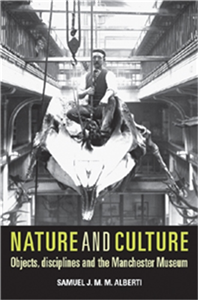
        Nature and culture

        Objects, disciplines and the Manchester Museum

        by Samuel J. M. M. Alberti

        This is a vital new work; the first to take the University of Manchester's Museum as its subject. By setting the museum in its cultural and intellectual contexts, Nature and culture explores twentieth-century collecting and display, and the status of the object in the modern world. Beginning with the origins of the Manchester Museum, accounting for its development as an internationally renowned university museum, and concluding at its major expansion at the turn of the millennium, this book casts new light on the history of museums. How did objects become knowledge? Who encountered museum objects on their way to museums? What happened to collections within the museum? How did visitors use and respond to objects? In answering these questions, Nature and culture illuminates not only the history of one institution, but also contributes to wider discussions in the history of science, cultural history and museology. ;

      • Trusted Partner
        Humanities & Social Sciences
        March 2026

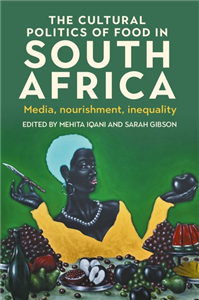
        The cultural politics of food in South Africa

        Media, nourishment, inequality

        by Mehita Iqani, Sarah Gibson

        Food is both a material system of nourishment, necessary for human survival, and a communicative system that signifies multiple meanings across human cultures. This book explores the cultural politics of food in the South African context, bringing together a range of disciplinary perspectives on the links between media, nourishment, and inequality. The chapters all highlight the multiplicity of meanings that food has in South African society. These include historical perspectives on the impact of colonialism, migration and apartheid had on food and foodways in South Africa; sociological interventions on food and society; aesthetic practices in relation to food; and mediated food cultures in South Africa. Taken together, the book critically explores the multiple ways in which food is never just food, and always linked to complex and shifting modalities of meaning and knowledge in the South African context.

      • Trusted Partner
        Humanities & Social Sciences
        March 2021

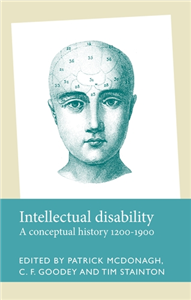
        Intellectual disability

        A conceptual history, 1200–1900

        by Patrick McDonagh, C. F. Goodey, Timothy Stainton

        This collection explores the historical origins of our modern concepts of intellectual or learning disability. The essays, from some of the leading historians of ideas of intellectual disability, focus on British and European material from the Middle Ages to the late-nineteenth century and extend across legal, educational, literary, religious, philosophical and psychiatric histories. They investigate how precursor concepts and discourses were shaped by and interacted with their particular social, cultural and intellectual environments, eventually giving rise to contemporary ideas. Intellectual disability is essential reading for scholars interested in the history of intelligence, intellectual disability and related concepts, as well as in disability history generally.

      • Trusted Partner
      • Trusted Partner
        Literature & Literary Studies
        March 2013

        The Intellectual and Cultural World of the Early Modern Inns of Court

        by Edited by Jayne Archer, Elizabeth Goldring and Sarah Knight

        This is a collection of essays on an important but overlooked aspect of early modern English life: the artistic and intellectual patronage of the Inns of Court and their influence on religion, politics, education, rhetoric, and culture from the late fifteenth through the early eighteenth centuries. This period witnessed the height of the Inns' status as educational institutions: emerging from fairly informal associations in the fourteenth century, the Inns of Court in the fifteenth and sixteenth centuries had developed sophisticated curricula for their students, leading to their description in the early seventeenth century as England's 'third university'. Some of the most influential politicians, writers, and divines - as well as lawyers - of Tudor and Stuart England passed through the Inns: men such as Edward Hall, Richard Hooker, John Webster, John Selden, Edward Coke, William Lambarde, Francis Bacon, and John Donne. This is the first interdisciplinary publication on the early modern Inns of Court, bringing together scholarship in history, art history, literature, and drama. The book is lavishly illustrated and provides a unique collection of visual sources for the architecture, art, and gardens of the early modern Inns ;

      • Trusted Partner
        March 2020

        No Place for Taste

        Food Myths and the Rapid Change of Food Culture

        by Manfred Kriener

        This book is not a manual but provides an information kit so we can find our way intelligently and make decisions. Nutrition is a constant talking point, but often there is a lack of knowledge and judgement. Amidst this confusion of facts, Manfred Kriener clarifies the rapid change of our food culture. He covers the entire range from the vegan trend to insect food, from aquaculture to cultured meat. Kriener also focuses on the various obscure quality seals, chaotic labelling on the wine rack and our inconsistency as consumers. The new world of food in eleven chapters, spicy at times, but plenty of food for thought and to whet the appetite.

      • Trusted Partner
        Humanities & Social Sciences
        December 2024

        British culture after empire

        Race, decolonisation and migration since 1945

        by Josh Doble, Liam Liburd, Emma Parker

        British culture after Empire is the first collection of its kind to explore the intertwined social, cultural and political aftermath of empire in Britain from 1945 up to and beyond the Brexit referendum of 2016, combining approaches from the fields of history, English and cultural studies. Against those who would deny, downplay or attempt to forget Britain's imperial legacy, the various contributions expose and explore how the British Empire and the consequences of its end continue to shape Britain at the local, national and international level. As an important and urgent intervention in a field of increasing relevance within and beyond the academy, the book offers fresh perspectives on the colonial hangovers in post-colonial Britain from up-and-coming as well as established scholars.

      • Trusted Partner
        Humanities & Social Sciences
        April 2024

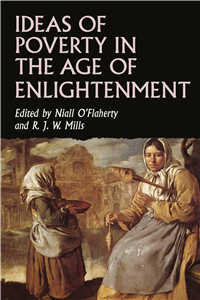
        Ideas of poverty in the Age of Enlightenment

        by Niall O’Flaherty, Robin Mills

        This collection of essays examines the ways in which poverty was conceptualised in the social, political, and religious discourses of eighteenth-century Europe. It brings together experts with a wide range of expertise to offer pathbreaking discussions of how eighteenth-century thinkers thought about the poor. Because the theme of poverty played important roles in many critical issues in European history, it was central to some of the key debates in Enlightenment political thought throughout the period, including the controversies about sovereignty and representation, public and private charity, as well as questions relating to crime and punishment. The book examines some of the most important contributions to these debates, while also ranging beyond the canonical Enlightenment thinkers, to investigate how poverty was conceptualised in the wider intellectual culture, as politicians, administrators and pamphlet writers grappled with the issue.

      • Trusted Partner
        The Arts
        August 2007

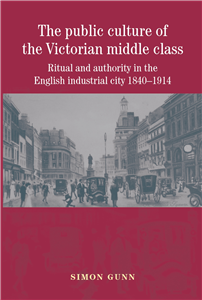
        The public culture of the Victorian middle class

        Ritual and authority in the English industrial city 1840–1914

        by Simon Gunn

        The public culture of the Victorian middle class looks at the creation of a distinctive 'high' culture in the industrial cities of Birmingham, Leeds and Manchester in the mid-nineteenth century and its incipient decline from the 1880s. The history of urban bourgeois culture has been relatively unexplored and under-theorised compared to popular culture. This volume therefore represents a significant contribution both to the study of middle-class cultural forms and to an understanding of the relationship between culture and power. In particular, it argues for the importance of ritualised modes of social behaviour in understanding the construction of authority in the nineteenth-century city. As well as many original arguments, the book provides a clear and useful overview of the public cultures of Victorian 'respectability'. The book will be of interest to scholars and students in the areas of social history, cultural history, urban history, cultural studies, urban studies and the sociology of culture. ;

      • Trusted Partner
        Humanities & Social Sciences
        July 2023

        A culture of curiosity

        by Leonie Hannan

      • Trusted Partner
      • Trusted Partner
        Industrial / commercial art & design
        April 2017

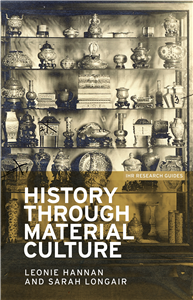
        History through material culture

        by Series edited by Simon Trafford, Leonie Hannan, Sarah Longair

        History through material culture is a unique, step-by-step guide for students and researchers who wish to use objects as historical sources. Responding to the significant, scholarly interest in historical material culture studies, this book makes clear how students and researchers ready to use these rich material sources can make important, valuable and original contributions to history. Written by two experienced museum practitioners and historians, the book recognises the theoretical and practical challenges of this approach and offers clear advice on methods to get the best out of material culture research. With a focus on the early modern and modern periods, this volume draws on examples from across the world and demonstrates how to use material culture to answer a range of enquiries, including social, economic, gender, cultural and global history.

      • Trusted Partner
        2023

        Food Composition Table for the Practice

        The small Souci/Fachmann/Kraut

        by Founded by S.W. Souci, W. Fachmann and H. Kraut. Revised by Dr. Petra Steinhaus. Edited by the Leibniz Institute of Food Systems Biology at the Technical University of Munich.

        ■ How many omega-3 fatty acids does salmon contain? ■ Which dairy product contains the most calcium? ■ How iron-rich is spinach, really? Whether calories, vitamins or amino acids – whether in field beans, bananas, eggs, chicken, parmesan cheese or onion – it is all here. The compact edition of the time-tested „large SFK [Souci/Fachmann/Kraut]“ offers tested data on over 70 ingredients in more than 360 foods, systematically structured according to food groups. This edition with thousands of values has been completely revised and updated by the Leibniz Institute of Food Systems Biology at the Technical University of Munich. Extra: 32 summary tables cover more than 300 other, less common foods and allow for targeted, clear comparisons. 16 orientation tables provide information about foods with particularly high or low amounts of ingredients. Nutritional values, energy content, main components and ingredients displayed in uniform systematics and a practical format – just look it up!

      • Trusted Partner
        Humanities & Social Sciences
        March 2017

        The harem, slavery and British imperial culture

        Anglo-Muslim relations in the late nineteenth century

        by Diane Robinson-Dunn

        This book focuses on British efforts to suppress the traffic in female slaves destined for Egyptian harems during the late-nineteenth century. It considers this campaign in relation to gender debates in England, and examines the ways in which the assumptions and dominant imperialist discourses of these abolitionists were challenged by the newly-established Muslim communities in England, as well as by English people who converted to or were sympathetic with Islam. While previous scholars have treated antislavery activity in Egypt first and foremost as an extension of earlier efforts to abolish plantation slavery in the New World, this book considers it in terms of encounters with Islam during a period which it argues marked a new departure in Anglo-Muslim relations. This approach illuminates the role of Islam in the creation of English national identities within the global cultural system of the British Empire. This book would appeal to those with an interest in British imperial history; Islam; gender, feminism, and women's studies; slavery and race; the formation of national identities; global processes; Orientalism; and Middle Eastern studies.

      • Trusted Partner
      • Trusted Partner
        Literature & Literary Studies
        February 2000

        Feminism, femininity and popular culture

        by Joanne Hollows

        Accessible, introductory student guide which identifies key feminist approaches to popular culture from the 1960s to the present.. The only introduction to both feminist cultural studies and feminism and popular culture published in the UK.. Presents its information in a reader friendly series of case studies on: women's film romantic fiction soap opera consumption and material culture fashion and beauty proactices youth culture and popular music. Will appeal to students across a wide range of disciplines as a variety of popular cultural forms are discussed. ;

      • Trusted Partner
        Humanities & Social Sciences
        July 2020

        Victorian literary culture and ancient Egypt

        by Eleanor Dobson

      • Trusted Partner
        Humanities & Social Sciences
        September 2008

        The culture of toleration in diverse societies

        Reasonable tolerance

        by Catriona McKinnon, Dario Castiglione

        The idea of toleration as the appropriate response to difference has been central to liberal thought since Locke. Although the subject has been widely and variously explored, there has been reluctance to acknowledge the new meaning that current debates on toleration have when compared with those at its origins in the early modern period and with subsequent discussions about pluralism and freedom of expression. This collection starts from a clear recognition of the new terms of the debate. It recognises that a new academic consensus is slowly emerging on a view of tolerance that is reasonable in two senses. Firstly of reflecting the capacity of seeing the other's viewpoint, secondly on the relatively limited extent to which toleration can be granted. It reflects the cross-thematic and cross-disciplinary nature of such discussions, dissecting a number of debates such as liberalism and communitarianism, public and private, multiculturalism and the politics of identity, and a number of disciplines: moral, legal and political philosophy, historical and educational studies, anthropology, sociology and psychology. A group of distinguished authors explore the complexities emerging from the new debate. They scrutinise, with analytical sophistication, the philosophical foundation, the normative content and the broadly political implications of a new culture of toleration for diverse societies. Specific issues considered include the toleration of religious discrimination in employment, city life and community, social ethos, publicity, justice and reason and ethics. The book is unique in resolutely looking forward to the theoretical and practical challenges posed by commitment to a conception of toleration demanding empathy and understanding in an ever-diversifying world. ;

      Subscribe to our

      newsletter