Your Search Results

      • Sharjah Documentation and Archives Authority

        Sharjah Documentation and Archives Authority, earlier Sharjah Centre for Documentation and Research, was established by resolution no. (4) of 2010, issued by His Highness Sheikh Dr. Sultan Bin Muhammad AL Qassimi, member of the Supreme Council, the Ruler of Sharjah. In 2016, H.H. Ruler of Sharjah issued resolution no. (4) of 2016, on the establishment of Sharjah Documentation and Archives Authority. The objectives were set to collecting and preserving documents related to the emirate, as well as the development of the documentation and archive system. Furthermore, the Authority shall oversee the management of current documents and mediate documents with concerned parties. The Authority represents the local body concerned with all matters of documents and archiving and it abides by the best international standards for preserving and maintaining documents. The Authority works to strengthen cultural and historical awareness and encourage scientific researches and intellectual creativity.

        View Rights Portal
      • Magic Author

        We are a one-stop platform to read, write, self-publish and sell ebooks in any of the Indian languages. Our mission is to empower the author's community with the digital tools and techniques, and we take care of the online presence of professionals in the publishing landscape, be they authors, publishers, editors, designers, publicists, etc.

        View Rights Portal
      • Trusted Partner
        Literature & Literary Studies
        January 2014

        Court and civic society in the Burgundian Low Countries c.1420–1530

        by Andrew Brown, Graeme Small

        This volume is the first ever attempt to unite and translate some of the key texts which informed Johan Huizinga's famous study of the Burgundian court, The Waning of the Middle Ages, a work which has never gone out of print. It combines these texts with sources that Huizinga did not consider, those that illuminate the wider civic world that the Burgundian court inhabited and the dynamic interaction between court and city. Through these sources, and an introduction offering new perspectives on recent historiography, the book tests whether Huizinga's controversial vision of the period still stands. Covering subjects including ceremonial events, such as the spectacles and gargantuan banquets that made the Burgundian dukes the talk of Europe, the workings of the court, and jousting, archery and rhetoric competitions, the book will appeal to students of late medieval and early modern Europe and to those with wider interests in court culture, ritual and ceremony.

      • Trusted Partner
        Literature & Literary Studies
        January 2013

        The towns of Italy in the later Middle Ages

        by Trevor Dean

        The towns of Italy in the later middle ages presents over one hundred fascinating documents, carefully selected and coordinated from the richest, most innovative and most documented society of the European Middle Ages. No other English language sourcebook has the same geographical or chronological range. This collection is carefully structured around the crisis of the fourteenth century and arranged in contrasting groups of texts. By connecting documents in translation to recent scholarship and debates, it addresses five key areas of medieval urban history: the physical environment, civic religion, economy, society and politics. Offers students well-translated and effectively contextualised documents along with some guidance to the secondary work of Italian scholars which is largely inaccessible to undergraduate students.

      • Trusted Partner
        Humanities & Social Sciences
        July 2022

        Jacopo da Varagine's Chronicle of the city of Genoa

        by C. E. Beneš

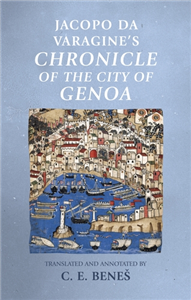
        This book offers the first English translation of the Chronicle of the city of Genoa by the thirteenth-century Dominican Jacopo da Varagine, an author best known for his monumental book of saints' lives, the Golden legend. Jacopo's Chronicle presents a coherent vision of Genoa's place in history, the cosmos and Creation as written by the city's own archbishop - mixing eyewitness accounts with scholarly research about the city's origins and didactic reflections on the proper conduct of public and private life. Accompanied by an extensive introduction, this complete translation provides a unique perspective on a dynamic medieval city-state from one of its most important officials, broadening the available literature in English on medieval Italian urban life.

      • Trusted Partner
        Humanities & Social Sciences
        November 2019

        Jacopo da Varagine's Chronicle of the city of Genoa

        by C. E. Beneš, Rosemary Horrox

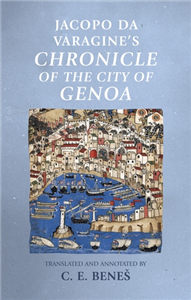
        This book offers the first English translation of the Chronicle of the city of Genoa by the thirteenth-century Dominican Jacopo da Varagine, an author best known for his monumental book of saints' lives, the Golden legend. Jacopo's Chronicle presents a coherent vision of Genoa's place in history, the cosmos and Creation as written by the city's own archbishop - mixing eyewitness accounts with scholarly research about the city's origins and didactic reflections on the proper conduct of public and private life. Accompanied by an extensive introduction, this complete translation provides a unique perspective on a dynamic medieval city-state from one of its most important officials, broadening the available literature in English on medieval Italian urban life.

      • Trusted Partner
        Humanities & Social Sciences
        November 2019

        Jacopo da Varagine's Chronicle of the city of Genoa

        by Carrie Beneš, Rosemary Horrox

        This book offers the first English translation of the Chronicle of the city of Genoa by the thirteenth-century Dominican Jacopo da Varagine, an author best known for his monumental book of saints' lives, the Golden legend. Jacopo's Chronicle presents a coherent vision of Genoa's place in history, the cosmos and Creation as written by the city's own archbishop - mixing eyewitness accounts with scholarly research about the city's origins and didactic reflections on the proper conduct of public and private life. Accompanied by an extensive introduction, this complete translation provides a unique perspective on a dynamic medieval city-state from one of its most important officials, broadening the available literature in English on medieval Italian urban life.

      • Trusted Partner
        Literature & Literary Studies
        May 2026

        Women’s Agency and the Gothic in Spain and the Americas

        by Megan DeVirgilis, Sandra García Gutiérrez

        This volume has emerged to fulfill two main purposes: Primarily, to constitute the first collaborative work that traces the relationship between the Gothic and Women in Spain and the Americas, but also, to surpass the term 'Female Gothic,' coined by Ellen Moers, by transferring the focus towards women and their agency as writers, readers and characters. This volume functions as a manifesto per se to open new avenues into understanding how women have interacted with the Gothic between the nineteenth and twenty-first centuries in Spain and the Americas. The question, we determine, is not simply about identity, but rather about agency. We define women's agency as the total capacity of characters, authors and readers to act freely within a social framework in relation to gothic texts. In our exploration of authorship, we reject the claim that the Gothic is a simplistic literary genre, instead sustaining that the plasticity of the Gothic has enabled it to survive for centuries; by shifting from a genre to a mode, it has surpassed literary forms and invaded all kinds of media: from film to music and merchandise such as clothing and pop culture collectables, fostering an authentic goth fandom.

      • Trusted Partner
        Literature & Literary Studies
        January 2023

        The gift of narrative in medieval England

        by Nicholas Perkins

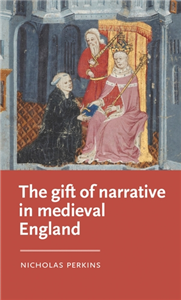
        This invigorating study places medieval romance narrative in dialogue with theories and practices of gift and exchange, opening new approaches to questions of storytelling, agency, gender and materiality in some of the most engaging literature from the Middle Ages. It argues that the dynamics of the gift are powerfully at work in romances: through exchanges of objects and people; repeated patterns of love, loyalty and revenge; promises made or broken; and the complex effects that time works on such objects, exchanges and promises. Ranging from the twelfth century to the fifteenth, and including close discussions of poetry by Chaucer, the Gawain-Poet and romances in the Auchinleck Manuscript, this book will prompt new ideas and debate amongst students and scholars of medieval literature, as well as anyone curious about the pleasures that romance narratives bring.

      • Trusted Partner
        Literature & Literary Studies
        September 2025

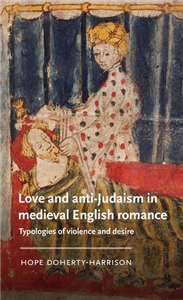
        Love and anti-Judaism in medieval English romance

        Typologies of violence and desire

        by Hope Doherty-Harrison

        Love and anti-Judaism is a new examination of medieval romance for the questions it poses of the most significant events in Christian history. Providing new readings of Sir Gawain and the Green Knight, Sir Orfeo, Sir Gowther and Sir Amadace, the book argues that romance explores depictions of love-and the sacrifices it may necessitate-in the Hebrew Bible, especially where they do not easily fit into interpretations asserting that this history must prefigure Christ and the crucifixion. An examination of anti-Judaism as a discourse of violence and desire that could be turned inwardly to expose the irresolution in Christianity, this book will provoke new investigations into the religious crises of medieval romance.

      • Trusted Partner
        The Arts
        June 2021

        Medieval film

        by Anke Bernau, Bettina Bildhauer

        Medieval film explores theoretical questions about the ideological, artistic, emotional and financial investments inhering in cinematic renditions of the medieval period. What does it mean to create and watch a 'medieval film'? What is a medieval film and why are they successful? This is the first work that attempts to answer these questions, drawing, for instance, on film theory, postcolonial theory, cultural studies and the growing body of work on medievalism. Contributors investigate British, German, Italian, Australian, French, Swedish and American film, exploring topics such translation, temporality, film noir, framing and period film - and find the medieval lurking in inexpected corners. In addition it provides in-depth studies of individual films from different countries including The Birth of a Nation to Nosferatu, and Robin Hood: Prince of Thieves. Medieval Film will be of interest to medievalists working in disciplines including literature, history, to scholars working on film and in cultural studies. It will also be of interest to undergraduates, postgraduates and to an informed enthusiast in film or/and medieval culture.

      • Trusted Partner
        The Arts
        January 2019

        Medieval film

        by Anke Bernau, Bettina Bildhauer

        Medieval film explores theoretical questions about the ideological, artistic, emotional and financial investments inhering in cinematic renditions of the medieval period. What does it mean to create and watch a 'medieval film'? What is a medieval film and why are they successful? This is the first work that attempts to answer these questions, drawing, for instance, on film theory, postcolonial theory, cultural studies and the growing body of work on medievalism. Contributors investigate British, German, Italian, Australian, French, Swedish and American film, exploring topics such translation, temporality, film noir, framing and period film - and find the medieval lurking in unexpected corners. In addition it provides in-depth studies of individual films from different countries including The Birth of a Nation to Nosferatu, and Robin Hood: Prince of Thieves. Medieval film will be of interest to medievalists working in disciplines including literature, history, art history, to scholars working on film and in cultural studies. It will also be of interest to undergraduates, postgraduates and to an informed enthusiast in film or/and medieval culture.

      • Trusted Partner
        Humanities & Social Sciences
        March 2020

        Medieval women and urban justice

        by Teresa Phipps, Cordelia Beattie

      • Trusted Partner
        Humanities & Social Sciences
        November 2025

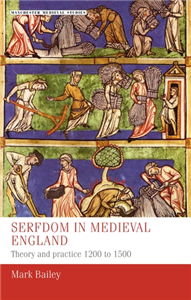
        Serfdom in medieval England

        Theory and practice 1200 to 1500

        by Mark Bailey

        Serfdom was a coercive relationship between a landowner and peasant, which was widespread across medieval and early modern Europe. Itfeatures prominently in major historical debates, such as the origins of capitalism and the divergent pathways of western and eastern Europe to modernity. Scholars have paid particular attention to English serfdom, which is usually portrayed as highly oppressive and a major cause of the Peasants' Revolt in 1381. This comprehensive survey draws on a vast scholarship and new research to show how, in reality, English serfdom was weak, casting new light on the nature of its society and economy when the Black Death struck in 1348-9. The pandemicnow assumesa central role in the rapid decline of serfdom, as illustrated in a case study of the estate of one of England's harshest landowners, St Albans abbey.

      • Trusted Partner
        Humanities & Social Sciences
        January 2013

        Crime, Law and Society in the Later Middle Ages

        by Anthony Musson, Edward Powell

        This book provides an accessible collection of translated legal sources through which the exploits of criminals and developments in the English criminal justice system (c.1215-1485) can be studied. Drawing on the wealth of archival material and an array of contemporary literary texts, it guides readers towards an understanding of prevailing notions of law and justice and expectations of the law and legal institutions. Tensions are shown emerging between theoretical ideals of justice and the practical realities of administering the law during an era profoundly affected by periodic bouts of war, political in-fighting, social dislocation and economic disaster. Introductions and notes provide both the specific and wider legal, social and political contexts in addition to offering an overview of the existing secondary literature and historiographical trends. This collection affords a valuable insight into the character of medieval governance as well as revealing the complex nexus of interests, attitudes and relationships prevailing in society during the later Middle Ages.

      • Trusted Partner
        Literature & Literary Studies
        May 2024

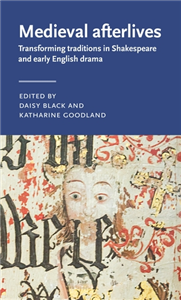
        Medieval afterlives

        Transforming traditions in Shakespeare and early English drama

        by Daisy Black, Katharine Goodland

        A collection of essays which show how early drama traditions were transformed, recycled, re-used and reformed across time to form new relationships with their audiences. Medieval afterlives brings new insight to the ways in which peoples in the sixteenth century understood, manipulated and responded to the history of their performance spaces, stage technologies, characterisation and popular dramatic tropes. In doing so, this volume advocates for a new understanding of sixteenth-seventeenth century theatre makers as highly aware of the medieval traditions that formed their performance practices, and audiences who recognised and appreciated the recycling of these practices between plays.

      • Trusted Partner
        Literature & Literary Studies
        October 2010

        Sanctity and pornography in medieval culture

        On the verge

        by Bill Burgwinkle, Cary Howie, Anke Bernau

        Sanctity and pornography in medieval culture exposes the complexity of bodily exposure in medieval devotion and contemporary pornographic cultures. Through readings of texts and images, sacred and profane, from preimodern France and Italy as well as Anglo-American modernity, the book makes a case for paying closer attention to the surfaces of our bodies and the desires that those surfaces can articulate and arouse. From the Old French life of Saint Alexis to the work of writer-filmmaker Miranda July, from Wakefield Poole to Pietro Aretino, these are texts and images that diminish the distance between premodern Europe and contemporary California, between the sacred and the profane, as they demonstrate how, in the end as in the beginning, the surface of things is never simple. ;

      • Trusted Partner
        Humanities & Social Sciences
        February 2023

        Globalized urban precarity in Berlin and Abidjan

        Young men and the digital economy

        by Hannah Schilling

        Digital technologies promise efficiency and comfort, but the smoothness of platform services relies on the hidden social labour of those who keep the gig economy running. This book presents a comparative ethnography of young men making a living through digital technologies: selling mobile airtime in Abidjan, Côte d'Ivoire, and app-based delivery riders in Berlin, Germany. These case studies explore the significance of symbolic capital in urban youth's social existence and organisation of livelihood in the digital economy, and the technological mechanisms producing a new form of urban precarity. Globalized urban precarity in Berlin and Abidjan puts forward an original comparative approach to develop a global urban sociology for the digital era. It provides an innovative analytical toolbox that decentres discussions of precarity from the standard of a normal employment contract. With its focus on symbolic capital, the ethnography shows the consequences of the proliferating gig economy for status struggles among urban youth, and carefully embeds the densification of software and services into the socio-material relations on which these new urban infrastructures are built.

      • Trusted Partner
        Geography & the Environment
        June 2025

        Demystifying informal urban design and planning

        Insights from Asia

        by Mahyar Arefi

        Touting informal settlements or informality in general as illegal, crime-ridden, unsafe, filthy, chaotic, and formal developments as legal, orderly or safe, and so forth has not solved anything and informality as a way of life or an economic reality lingers and grows. Demystifying informal urban design and planning delves deeper into this conundrum and seeks to debunk some common misguided perceptions about it. Borrowing popular philosophical and political analogies from Isaiah Berlin and Gregory Treverton and others, it encourages urban designers and planners to become multitaskers like foxes rather than hedgehogs who can do one thing right. The book ends with some general takeaways on assuming more proactive roles in informal urban design issues and avoiding two potential pitfalls while interacting with them.

      • Trusted Partner
        Literature & Literary Studies
        June 2026

        The politics of Middle English parables

        Fiction, theology, and social practice

        by Mary Raschko

        The politics of Middle English parables examines the dynamic intersection of fiction, theology and social practice in late-medieval England. Parables occupy a prominent place in Middle English literature, appearing in dream visions and story collections as well as in lives of Christ and devotional treatises. While most scholarship approaches the translated stories as stable vehicles of Christian teaching, this book highlights the many variations and points of conflict across Middle English renditions of the same story. In parables related to labour, social inequality, charity and penance, the book locates a creative theological discourse through which writers attempted to re-construct Christian belief and practice. Analysis of these diverse retellings reveals not what a given parable meant in a definitive sense but rather how Middle English parables inscribe the ideologies, power structures and cultural debates of late-medieval Christianity.

      Subscribe to our

      newsletter