
Your Search Results


-
Promoted Content

 Humanities & Social SciencesMay 2026
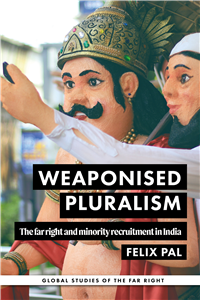
Weaponised pluralism
The far right and minority recruitment in India
by Felix Pal
Weaponised pluralism takes a fine-grained lens to understand why far-right organisations recruit from the very minorities they oppose. Why do these organisations seek to appear like pluralists? Building on his time with the Muslim wing of the Hindu far-right in India, Felix Pal proposes that bigots can strategically use what he calls weaponised pluralism. This political strategy counterintuitively uses progressive political performances to bolster bigoted political agendas. Basing his analysis in an Indian context, Weaponised pluralism nonetheless reveals much about contexts as varied as Palestinian soldiers in the Israeli army, Indigenous Australians on far-right television, and Black congressional candidates in the American Republican Party. Drawing on rare access to the Hindu far-right and its Muslim wing, Pal paints an evocative picture of the complexities of how far-right organising extends far beyond the pointy end of traditional bigotry.
-
Promoted Content
-
 Trusted Partner
-
Trusted Partner
 The ArtsJanuary 2021
There is no soundtrack
Rethinking art, media, and the audio-visual contract
by Ming-Yuen S. Ma
There is no soundtrack is a study of how sound and image produce meaning in contemporary experimental media art by artists ranging from Chantal Akerman to Nam June Paik to Tanya Tagaq. It contextualises these works and artists through key ideas in sound studies: voice, noise, listening, the soundscape and more. The book argues that experimental media art produces radical and new audio-visual relationships challenging the visually dominated discourses in art, media and the human sciences. In addition to directly addressing what Jonathan Sterne calls 'visual hegemony', it also explores the lack of diversity within sound studies by focusing on practitioners from transnational and diverse backgrounds. As such, it contributes to a growing interdisciplinary scholarship, building new, more complex and reverberating frameworks to collectively sonify the study of culture.
-
Trusted Partner
-
Trusted Partner
-
Trusted Partner
-
Trusted Partner
 June 2025
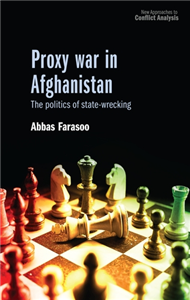
Proxy war in Afghanistan
The politics of state-wrecking
by Abbas Farasoo
This book provides a compelling analysis of proxy warfare and its far-reaching implications for statehood, focusing on the conflict in Afghanistan. Introducing the innovative concept of "state-wrecking," it bridges theory and practice to unravel how external support for insurgent actors fuels violence, undermines territorial control and sovereignty, intensifies violence, and dismantles political legitimacy. The work shifts the discourse on proxy wars from the strategies of global powers to the procedural and structural impacts within target states. Grounded in rigorous empirical research, including interviews, archival data, and conflict analysis, the book critically examines the Pakistan-Taliban nexus and the limitations of US-led interventions. By blending a robust theoretical framework with in-depth case studies, it reveals how proxy dynamics shape conflicts, disrupt governance, and challenge international security. This is an essential resource for those seeking to understand the entanglements of modern warfare and the fragility of states under external influence.
-
Trusted Partner
 Humanities & Social SciencesSeptember 2020
Queer Muslim diasporas in contemporary literature and film
by Alberto Fernández Carbajal, Amina Yaqin
-
Trusted Partner
-
Trusted Partner
-
Trusted Partner
 The ArtsFebruary 2022
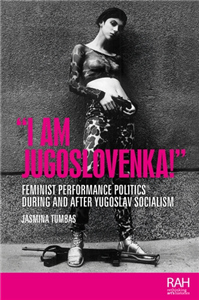
"I am Jugoslovenka!"
Feminist performance politics during and after Yugoslav Socialism
by Jasmina Tumbas, Amelia Jones, Marsha Meskimmon
"I am Jugoslovenka" argues that queer-feminist artistic and political resistance were paradoxically enabled by socialist Yugoslavia's unique history of patriarchy and women's emancipation. Spanning performance and conceptual art, video works, film and pop music, lesbian activism and press photos of female snipers in the Yugoslav wars, the book analyses feminist resistance in a range of performative actions that manifest the radical embodiment of Yugoslavia's anti-fascist, transnational and feminist legacies. It covers celebrated and lesser-known artists from the 1970s to today, including Marina Abramovic, Sanja Ivekovic, Vlasta Delimar, Tanja Ostojic, Selma Selman and Helena Janecic, along with music legends Lepa Brena and Esma Redzepova. "I am Jugoslovenka" tells a unique story of women's resistance through the intersection of feminism, socialism and nationalism in East European visual culture.
-
Trusted Partner
 The ArtsJanuary 2019
Algerian national cinema
by Guy Austin
This topical and innovative study is the first book on Algerian cinema to be published in English since the 1970s. At a time when North African and Islamic cultures are of increasing political significance, Algerian National Cinema presents a dynamic, detailed and up to date analysis of how film has represented this often misunderstood nation. Algerian National Cinema explores key films from The Battle of Algiers (1966) to Mascarades (2007). Introductions to Algerian history and to the national film industry are followed by chapters on the essential genres and themes of filmmaking in Algeria, including films of anti-colonial struggle, representations of gender, Berber cinema, and filming the 'black decade' of the 1990s. This thoughtful and timely book will appeal to all interested in world cinemas, in North African and Islamic cultures, and in the role of cinema as a vehicle for the expression of contested identities. By the author of the critically-acclaimed Contemporary French Cinema.
-
Trusted Partner
 The ArtsJune 2021
Algerian national cinema
by Guy Austin
This topical and innovative study is the first book on Algerian cinema to be published in English since the 1970s. At a time when North African and Islamic cultures are of increasing political significance, Algerian National Cinema presents a dynamic, detailed and up to date analysis of how film has represented this often misunderstood nation. Algerian National Cinema explores key films from The Battle of Algiers (1966) to Mascarades (2007). Introductions to Algerian history and to the national film industry are followed by chapters on the essential genres and themes of filmmaking in Algeria, including films of anti-colonial struggle, representations of gender, Berber cinema, and filming the 'black decade' of the 1990s. This thoughtful and timely book will appeal to all interested in world cinemas, in North African and Islamic cultures, and in the role of cinema as a vehicle for the expression of contested identities. By the author of the critically-acclaimed Contemporary French Cinema.
-
Trusted Partner
 December 2026
Qatar and Iran
Strategic hedging in small states foreign policy
by Mirdef Alqashouti
How was the 2017 Qatar Blockade crisis shaped by the history of diplomatic relations between Qatar and Iran? What foreign policy strategies has Qatar adopted in response to this crisis? How can we better conceptualise the limits of the relations between Qatar and Iran? This book examines the evolving nature of Qatar and Iran's diplomatic relations. Using historical analysis and first-hand accounts of high-level officials from both countries, especially in the aftermath of the 2017 Qatar Blockade crisis, it reveals a multifaceted and dynamic interaction between Qatar and Iran extending beyond politics into the realms of economics, tourism and culture. This book provides insights on the strategies small states implement in international relations, as well as contributes to understandings of geopolitics in the Middle East.
-
Trusted Partner

 February 2026
Wassili Waschbär (3). Wo immer wir zusammen sind, ist es am allerschönsten
Eine berührende Bilderbuchgeschichte über den Wert eines liebevollen Zuhauses zum Vorlesen ab 3 Jahren
by Julia Boehme, Stefanie Dahle
Die Fortsetzung des Bilderbucherfolgs von Julia Boehme: eine berührende Geschichte über das Glück Geborgenheit zu erfahren. Wassili Waschbär und Sibelius, der Dachs, überlegen, wo es am allerschönsten ist. Vielleicht genau hier zusammen in der Hängematte? Eine Schwalbe hört das mit an und sagt, dass die beiden keine Ahnung haben, weil sie ja noch nichts von der Welt gesehen haben … Also beschließen die beiden Freunde, einmal selbst nachzusehen. Bei der Hummel auf der Blumenwiese ist es schön bunt, vom Eichhörnchen-Baum kann man weit gucken und bei den Fröschen ist es herrlich nass. Doch plötzlich ist Sibelius verschwunden, und Wassili beschließt, allein zurück nach Hause zu gehen. Ob hier die Antwort auf ihn wartet? Mit traumschönen Bildern in Szene gesetzt von der Bestseller-Illustratorin Stefanie Dahle. Zum Vorlesen für Jungen und Mädchen. Weitere Abenteuer mit Wassili Waschbär:Zum Glück hat man FreundeDas große Wunschzettel-Wunder
-
Trusted Partner
 Humanities & Social SciencesJanuary 2026
Surviving repression
The Egyptian Muslim Brotherhood after the 2013 coup
by Lucia Ardovini
Surviving repression tells the story of the Muslim Brotherhood following the 2013 coup d'état in Egypt. The Brotherhood gained legal recognition and quickly rose to power after the 2011 Arab uprisings, but its subsequent removal from office marked the beginning of the harshest repression of its troubled history. Forced into exile, the Brotherhood and its members are now faced with a monumental task as they rebuild this fragmented organisation. Drawing on extensive fieldwork and interviews with current and former members of the Brotherhood, the book explores this new era in the movement's history, emphasising first-hand experiences, perspectives and emotions to better understand how individual responses to repression are affecting the movement as a whole. Surviving repression offers a unique insight into the main strategic, ideological and organizational debates dividing the Brotherhood.
-
Trusted Partner
-
Trusted Partner
 Humanities & Social SciencesMarch 2026
Revolutionary anxieties
Defending privilege in the wake of the 2011 Egyptian Revolution
by Liina Mustonen
Revolutionary anxieties sheds light on an unexplored dimension of the 2011 Egyptian revolution: the anxieties experienced by Cairo-based liberal elite, socialites, and cultural actors who opposed the rise of the new political actors, the Muslim Brotherhood. This book provides fresh insights into the failure of the Egyptian revolution by examining the perspectives of those who had a vested interest in maintaining the status-quo. It engages with post-colonial theory and examines the elite milieu in Cairo through the lenses of gender and race. Based on over two years of ethnographic research in various elite locations such as the Cairo Opera House, an Egyptian-European film festival, and an elite sporting club in Cairo, the book illustrates how members of Egyptian liberal upper class insisted on their privilege in a moment when the country's class hierarchies were challenged. By revealing the prevalence of counter-revolutionary sentiment among Cairo's liberal and affluent elite, the book tells an untold story of the Arab Spring.
-
Trusted Partner
 Humanities & Social SciencesDecember 2024
Iran, Saudi Arabia and the United States
Power, identity and strategy in the Persian Gulf triangle
by Luíza Cerioli
This book offers a nuanced snapshot of the complex geopolitical dynamics in the Persian Gulf, underlining the interaction between Iran, Saudi Arabia, and the US. Examining their interwoven relations since the 1970s, Luíza Cerioli's framework reveals how changes in US-Saudi ties have ripple effects on Iran-US and Iran-Saudi relations and vice versa. Using a historical lens, she explores how enduring US-Saudi connections hinge on order expectations, delves into the cognitive factors shaping US-Iran enmity and traces the source of oscillation in the Saudi-Iran ties. Employing Neoclassical Realism, the book investigates status-seeking, national identities and leadership preferences, offering a deeper understanding of the region's multipolar system. By combining International Relations and Middle East Studies, Cerioli's work contributes to both fields, unravelling the intricate interplay between international structures, regional nuances and agency in shaping Persian Gulf geopolitics.



